

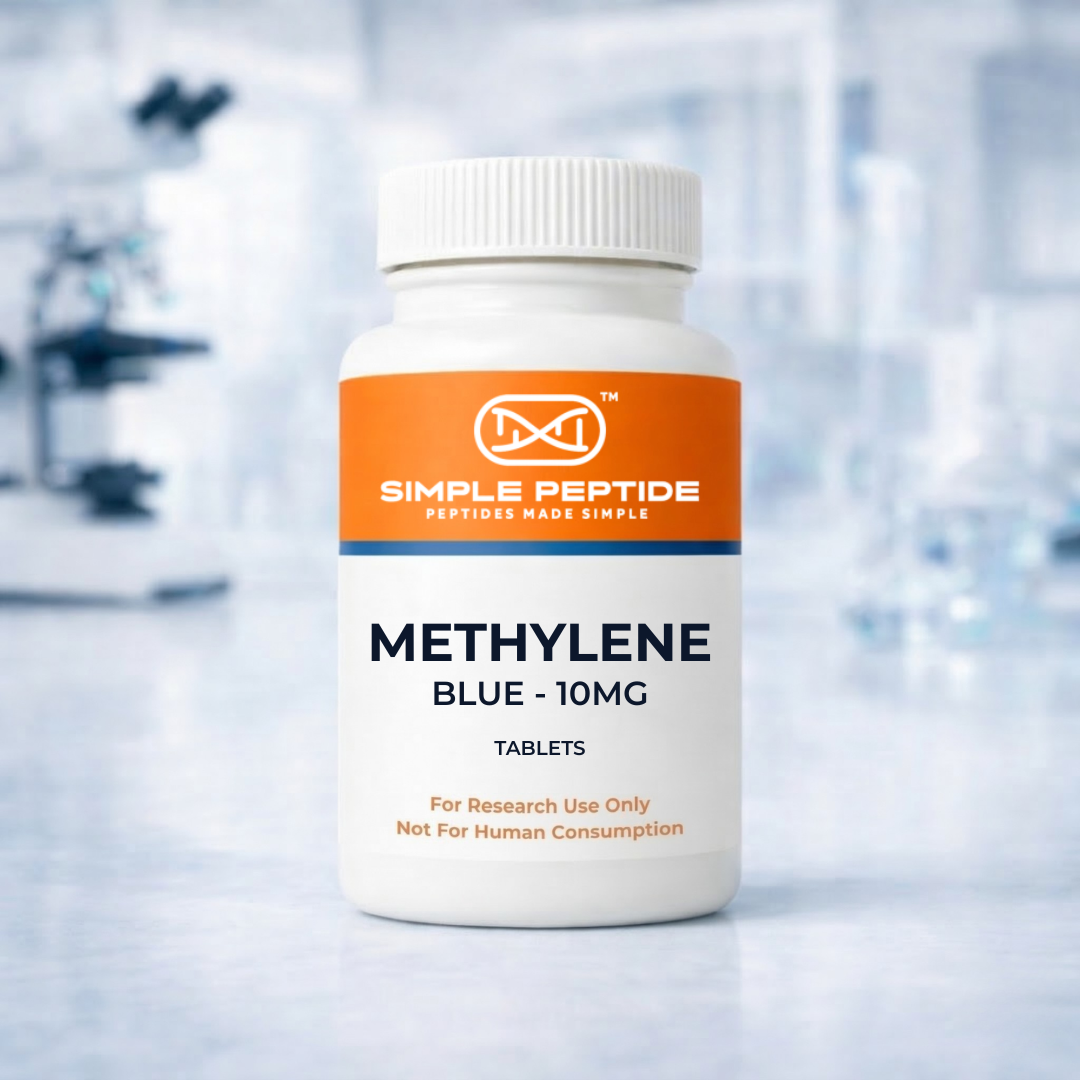
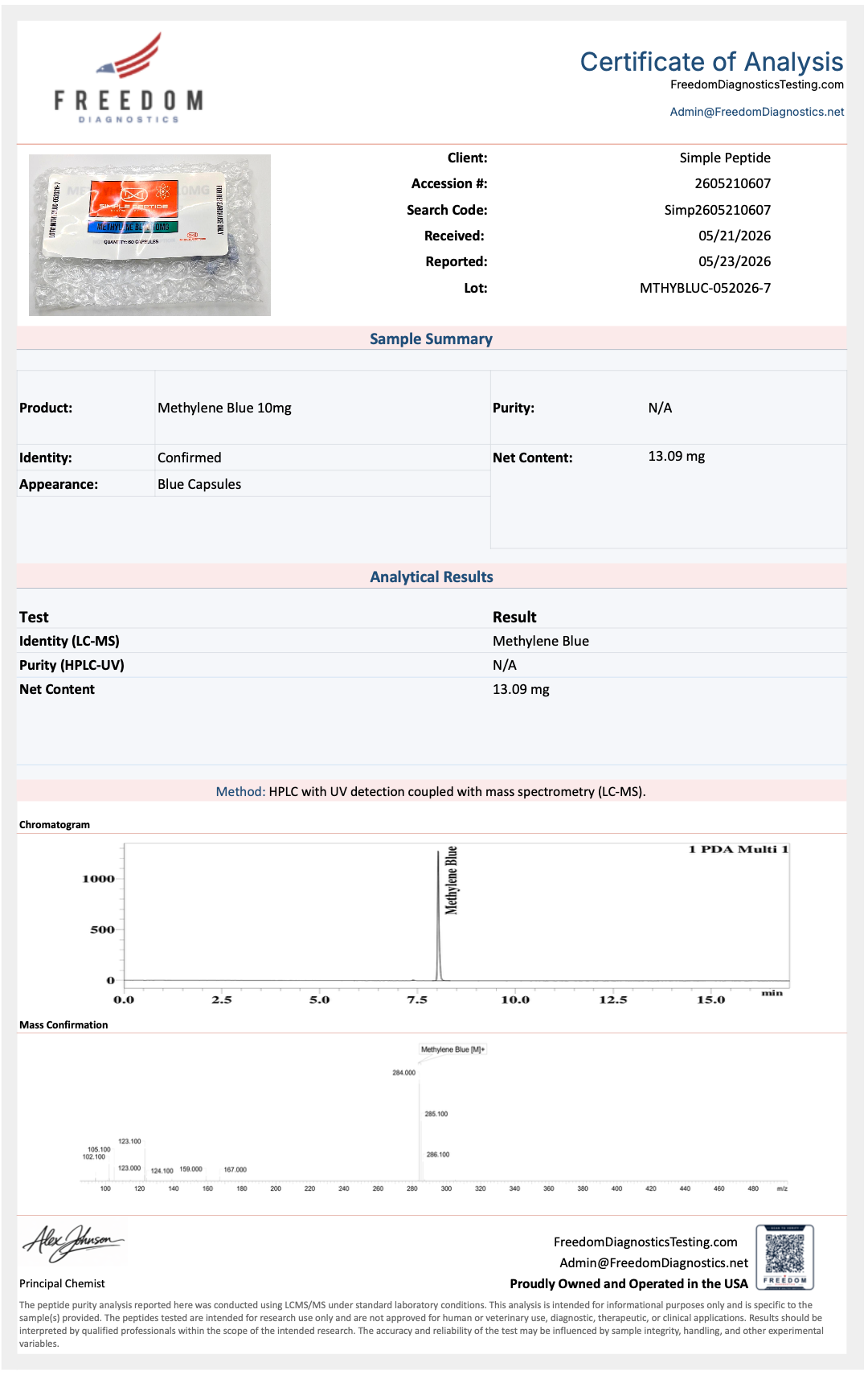
Methylene Blue (Methylthioninium Chloride)
Chemical Profile and Transport Dynamics
Methylthioninium Chloride (MB) is a foundational phenothiazine derivative characterized by a planar, conjugated tricyclic ring system. This compound is amphiphilic (both lipophilic and hydrophilic), a property that imparts high membrane permeability and allows for unhindered passage across lipid barriers. Following systemic administration, the molecule exhibits a remarkably large volume of distribution, indicating extensive tissue uptake and cellular sequestration within highly metabolic structures.
Mechanisms of Cellular Bioenergetics and Redox Modulation
MB’s primary attribute is its powerful auto-oxidizing redox capacity, enabling it to oscillate reversibly and rapidly between its deep blue oxidized state and its colorless reduced state (leucomethylene blue). At relevant concentrations, MB functions as an exogenous electron cycler within the mitochondrial electron transport chain (ETC).
- ETC Bypass: MB accepts electrons from NADH (Complex I) and transfers them to Cytochrome c (Complex IV), sustaining the ETC’s proton-pumping capacity and supporting cellular ATP synthesis even in the presence of severe metabolic blockages.
- Biogenesis Induction: The action of MB triggers a transcriptional cascade that drives the long-term enzymatic induction and upregulation of Complex IV subunits, thereby promoting mitochondrial biogenesis and structural restoration.
- Multi-Target Modulation: MB is a multi-target network modulator, interacting with cellular systems based on local thermodynamic and redox gradients, leading to a biphasic (hormetic) response profile.
Summary of Clinical Evaluation Outcomes
The methylthioninium moiety has been evaluated across various therapeutic areas, leveraging its capacity to modulate systems-level pathology:
- A Phase 2 Randomized Controlled Trial (RCT) evaluated MB as an adjunctive antimalarial, demonstrating its capacity to block transmission. Male participants treated with a combination including MB experienced a complete blockade of transmission to Anopheles vectors within 48 hours of starting treatment. (Drugs that reduce transmission of falciparum malaria – PMC – NIH)
- The compound hydromethylthionine mesylate (HMTM), a stable reduced form, was evaluated in the global Phase 3 LUCIDITY clinical trial. Modified analyses demonstrated that mild cognitive impairment participants receiving HMTM achieved sustained cognitive improvement over baseline for 78 weeks and showed a significant reduction in whole-brain and temporal lobe atrophy rates compared to external placebo controls. (Phase III trial suggests oral tau aggregation inhibitor may slow early Alzheimer’s disease progression)
- Prospective clinical trials characterized the physiological impact of intravenous administration in refractory septic shock, noting that it produced a transient increase in mean arterial pressure and a reduction in blood lactate concentrations. (Methylene blue administration in septic shock: a clinical trial)
Be the first to review “Simple Peptide Methylene Blue capsules”
Related products
Uncategorized
Uncategorized
Uncategorized
Uncategorized

Uncategorized
Uncategorized
Uncategorized
Reviews
There are no reviews yet.